“Don’t say you hate L.A. when you don’t travel past the 10”
Kendrick Lamar
I.
When I think about manmade American monuments that will outstand the tests of time, iconic in their visage and lasting in image, I think of the American freeway system. There are probably many other things that have been photographed more, written about more, discussed more. But, the freeway is probably the most culturally divisive. They form real social and economic barriers and ironically sprung from what at the time was a pretty progressive idea. Short lesson: General Eisenhower does some war stuff in Germany during World War II, observes the expansive and generous network of roads; the Autobahn. These roads, funded publicly for the public good, made it real easy for Allied forces to move tanks and troops around. They work really well for social and commerce activity. He becomes president in 1953 and lays out an infrastructure plan to build the nations interstate. The Dwight D. Eisenhower National System of Interstate and Defense Highways (National Highway System, for short) is essentially a culmination of numerous policies the US enacted to build working roadways as demand for paved roads increased (check out the Federal Aid Road Act of 1916 and Federal Aid Highway Act of 1921). The NHS was numbered, open access, and connected parts of the country that were sparsely benefitted by existing highways.
Freeways have always been an interesting and troubling thing to discuss when talking about society. For some people they are delivering on their progressive promise. They connect communities that otherwise would not have been connected. They ease travel planning. You can hop on in Santa Monica and Not have to stop till Phoenix (theoretically). They enable commerce. Trucks can move goods at speed and over distance. They fulfill the need for short range delivery of stuff and things. Hell, we have an entire city in California, Fresno, that is staking its economic future on being the Tennessee of the West Coast. A nexus through which all goods travelling East and entering West must pass through. The warehouse capital of California.
On the other hand, they exist as real social barriers whether real or intended. This is not a writing on the history of the American freeway and it’s sociopolitical reality, such a topic would fill its own series of essays. In short though, freeways were often constructed with the intent of destroying Black and Brown neighborhoods in Los Angeles. The committees formed to scout new freeway construction areas were composed primarily of the cities academic and political elite. Members of the communities affected never received chances to weigh in on such decisions.
“City officials would many times consider areas of predominantly Mexican, African-American, Italian, Irish, and Russian Jewish residents as slums. They often believed that these freeway construction projects would help eliminate them from the city landscape and simultaneously improve commerce and travel.”
Jovanni Perez
Freeways were devised to strategically divide up the good real estate from the bad. The inner city from the suburbs. The creation of a modern Los Angeles depended on displacing as many poor non-whites as possible.
If you live in Los Angeles chances are you live within a maddening distance of a Freeway. It’s either way too close or way too far to access. It probably isn’t often that a recent transplant, a yuppie, or a tourist will ever think about what these very expensive concrete monoliths actually mean to people other than as being traffic factories.
I have previously written about manufactured social barriers elsewhere. In a short political biography I wrote of my own mother, she remarks on how prior to the construction of the 10 freeway they didn’t know what it was. For them, the real barrier separating divisions of the city of Los Angeles were Long Beach Boulevard and Central Avenue. These barriers were explicitly racial. For much of Los Angeles’ history the inner areas closer to the city center were considered the domain of the working class, the poor, the skids, the black and latino population. These populations spread southwards and eastwards organically as the work on the numerous ranches and other industrial sectors moved inward. The good real estate always remained northwards, among the hills and close to the ocean and so, the media that portrays Los Angeles has always faced North. That’s where Hollywood is. That’s where Beverly Hills is. That’s where the Palisades are. But North of what exactly? What defines North from South in a city that is nearly 500 square miles in size and why would such a division be perceived in the first place?
II.
It is difficult to define what South Central is. As far as I know there is no consensus. Angelenos do not and have never cared about the scientific reality of place. We could state “South Central Los Angeles is vaguely a 16 square mile rectangle with two prongs at the bottom and constituted of these neighborhoods” and some city councilman will still swear that West Adams, should not be included. Older people who were alive in the 70s and 80s might say Baldwin Hills and parts of Jefferson Park shouldn’t be included. What we do know is that South LA is roughly bordered by freeways. Namely, the 10 to its North and the 105 to the South. The 110 cuts off the more Eastern neighborhoods pretty harshly from the West, forming a more noticeable subdivide apparent to travelers going East. the neighborhoods seem to get older and feel much more poorly maintained as you move closer to the city center and inevitably into East LA proper. Not for nothing have the neighborhoods of Florence and South Park been used repeatedly by mayors in my lifetime to evidence urban decay and a need for renewal. As compared to Baldwin Hills, the “Black Beverly Hills”, Vermont Square might as well be what people’s historical conception of Watts is. The two neighborhoods are almost exactly 3 miles apart. The section of the 10 Freeway expanding from the 405 to the 110 is named the “Rosa Parks Freeway” after having its name changed from Christopher Columbus who, and I could not find a source to verify this, never drove a car.
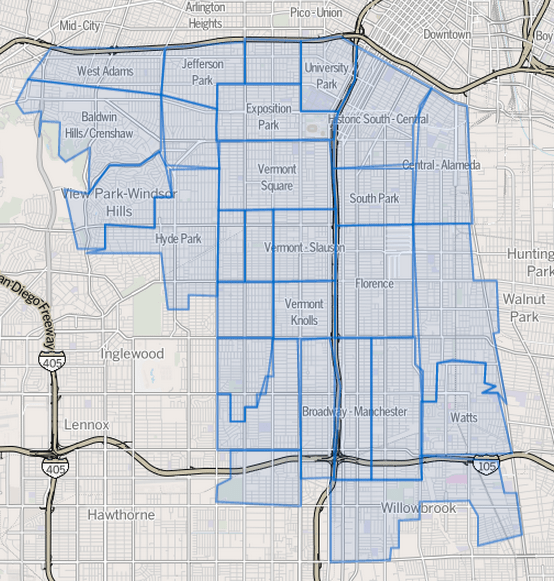
Comparatively, it’s very easy to define what is not South Central. You see it all the time. If there is a piece of visual media on TV or elsewhere it is most likely depicting Other parts of Los Angeles. Our media tends to face North. That’s where the actual cultural landmarks of Los Angeles are placed. I say placed because rarely are these features organic. The famed Hollywood sign was a marketing gimmick for a housing development. West Hollywood is famously a planned community and economic development zone that better represents an outdoor theme park version of TV Los Angeles. But to the North and West is where all the cool stuff is. Still there are parts of South Central that aim to one day not to have to bear the association. West Adams for instance has been undergoing a lengthy period of gentrification that identifies it more with the much trendier ‘Mid-City’ than South LA. A majority of said gentrification is occurring West of Crenshaw Blvd.
But what is in South LA? Quite a bit. The famed University of Southern California, although it purports not to be, is nestled firmly at the Northeast corner itself bound by the 10 and 110 freeways. Watts Towers is in Watts. The cultural and demographic center for Black People in Los Angeles is located in Leimert Park. Crenshaw Boulevard spans nearly the entirety of your drive until you’ve arrived in Hawthorne. But naming these places means nothing, they are most associated still with infamy rather than any positive attributes. History has a way of doing that. The Watts towers, as culturally relevant and beautiful as they are, require a trip to Watts. Watts at a time was considered to be the most dangerous individual neighborhood in the United States.
Los Angeles mocks anyone who attempts to describe in a unified framework the diverse and vast landscape it occupies. It is not a unitary ecology, it’s an ecology of ecologies, each distinct in its own way. Gardena is not Inglewood, though they are next to each other. Santa Clarita and El Monte, although far apart in distance, are so distant culturally and ethnically they might as well be different countries. In many ways they are. The nearby area of Newhall is known to, somewhat paradoxically, feature residents who prominently display Confederate Flags. These differences give evidence of a type of micro-regionality I haven’t experienced in many other places. I can discuss how close Santa Monica is to Venice Beach in terms of miles but they rest in completely different cities separated basically by a street. On a simple five mile drive down Sepulveda one can experience a trip through four different cities.
III.
If a tourist or friend were to visit they would want to see the cool stuff and I think it’s the failure of every Angeleno to drag said friend to a rooftop bar on Melrose rather than the Rose Garden in Expo Park. My sincere belief on why people claim to “hate” Los Angeles is because the image they are sold of LA is vastly different from any possible experience they can have while here. Yes, you want to go to Silver Lake but upon close inspection one realizes there really isn’t anything to do there but be there. There are no real star attractions culturally. No huge commerce centers like malls or similar. There are bars, nightlife attractions, music venues. Things that aren’t really active in the daytime. West Hollywood is roughly the same. It’s our best interpretation of a tourist trap. The best taco stands are in South LA.
The LA North of the 10 is what’s sold to you and the general masses while the LA South of the 10 is, well, Los Angeles. Perhaps the reputation for LA being a phony and glossy place comes from too many people who have visited and bought the image sold to them on Hollywood rather than the one on Figueroa. Many people will come here and spend a majority of their time chasing the nice. Why wouldn’t they? Although if I spent my time in a place concocted to give a specific image of a place and people that can be easily reproduced on TV, I might spend a little time calling said people fake, devised, or artificial.
We are still living in a time of political and social inertia started nearly a hundred years ago. Indeed possibly older. The efforts to “modernize” LA have for most people always meant to divide LA by race and possibly as likely, class. We won’t say it out loud but the terms “South LA” and “East LA” conjure up certain ideas for Angelenos that have a more complex effect on visitors. Visitors know South LA is different but they just don’t know why. Nobody ever talks about it. But they know like we know, that’s where the minorities are. South of the 10 is where the minorities live. There are no rooftop bars in South LA (yet). There aren’t any cultural relics that could be associated with a non-Angeleno or a non-white visitor. And as diverse as LA claims to be it has never really leaned into this diversity outwardly unless politically motivated to do so. When a movie studio willingly opens a lot in South LA we might see something like that but I doubt we will see such a change in our lifetime. South LA is an area LA claims strength from but takes no pride in. As evidenced in the early 2000’s when we as residents were directed to stop using ‘South Central’ and start using ‘South LA’ so as to not carry on the negative connotations associated with gang culture or whatever. As if shaming people for a history will convince them to invest further in their sense of place. For years hating Los Angeles has been kind of a trendy behavior to engage in for one reason or another. Our own politicians do it. We have had consecutive mayors who have no actual interest in liking this town.
The solution is to obviously start with facing South. People are allowed to like Los Angeles. The problem is about only 20% of our total city is the representative for all of it. The other problem? Convincing millions of people that the areas designed to draw attention from and divest from Black and Brown neighborhoods can actually be seen second instead of first. Maybe it’s just easier to sell the concept of a rooftop bar on Sunset. Selling the idea of a people and a city with all of its parts intact is a much more complex task.
When I went to America, her message had so sunk into my ears that I became a radical. I went to America to study at the University of California, where a jurist of international law was teaching. I wanted to take my degree in international law. And that was the period of McCarthyism, of the Communist witch hunts—my choices were laid out. To get away from Sunset Boulevard, from the girls with red nail polish, I ran off to Maxwell Street and lived among the Negroes. A week, a month. I felt good with them—they were real, they knew how to laugh. And the day in San Diego when I wasn’t able to get a hotel room because I have olive skin and looked like a Mexican … well, that helped.
Zulfikar Ali Bhutto
Citations and Readings
Perez, J. “The Los Angeles Freeway and the History of
Community Displacement”
Banham, R. (1971). Los Angeles: The Architecture of Four Ecologies. https://ci.nii.ac.jp/ncid/BA40230451
Rosas, A. (2019). South Central is home: race and the power of community investment in Los Angeles.
 Way Past Policy